Craig, Edward. 2020. Philosophy: A Very Short Introduction. Oxford. ** 1/2
A small book in Oxford’s “A Very Short Introduction” series. Unlike the Nagel volume, this one does discuss a number of specific philosophers and their arguments, and in a chronological framework. The author considers philosophy’s three big questions to be: What should we do? What is there? and, How do we know? Topics include the Crito of Plato, Hume’s argument about miracles, a Buddhist text about Nagasena; general topics and various “isms”; and “high spots” Descartes, Hegel, Darwin, and Nitzsche. And then free will, and asking, what is philosophy for? (post) (Read Jan 2024)
- Doxiadis, Apostolos, & Papadimitriou, Christos H.. 2009. Logicomix. Bloomsbury. –
Notes forthcoming
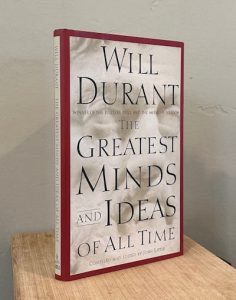 Durant, Will. 2002. The Greatest Minds and Ideas of All Time. Simon & Schuster. ** 1/2
Durant was a well-known historian and public intellectual up until his death in 1981; his major work was the 11-volume THE STORY OF CIVILIZATION, written with his wife. This book is a compilation of various essays, presumably from magazines, amounting to a philosophy fan-boy’s collection of top ten lists. So we get the ten greatest thinkers, ten greatest poets, a hundred best books for an education, and so on. He defends the “great man” theory of history, and his certainty about his choices seems immune from reconsideration (e.g. whether Plato was actually correct or not). At the same time he anticipates Steven Pinker’s later ideas about the progress of morality through the ages. And a quote from Durant’s Wikipedia page reveals his notions about the inevitable decline and rebuilding of civilizations, due to clash between knowledge and mythology/religion. (post) (Read Jan 2024)
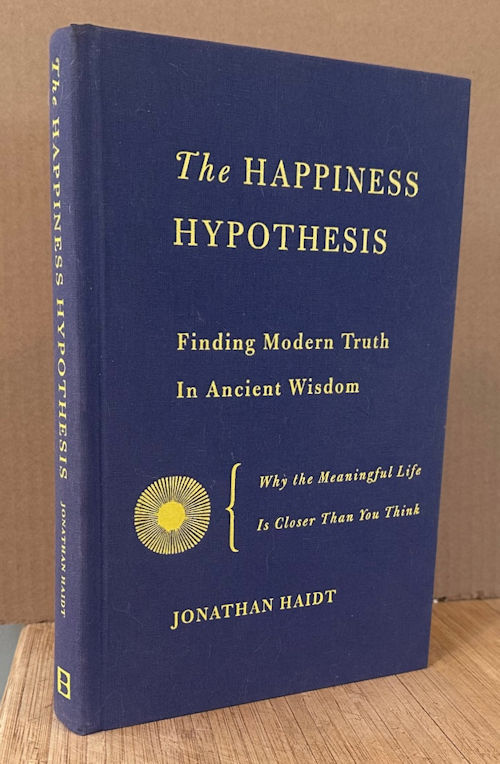 Haidt, Jonathan. 2006. The Happiness Hypothesis: Finding Modern Truth in Ancient Wisdom. Basic Books. *** 1/2
Haidt surveys ten “great ideas” discovered by the world’s civilizations about how to live and how to be happy, and considers them in light of current scientific understanding. For instance, it’s long been supposed that the mind is split in some fashion, e.g. mind vs. body; now we know it’s split in four ways: mind vs. body, left vs. right, new vs. old, and controlled vs. automatic. Other topics consider traditional notions of the golden rule, how happiness comes from within, how what doesn’t kill you makes you strong, and the meaning of life. Most of the traditional notions have turned out too simplistic. A modern understanding of happiness isn’t to abandon all attachments, it’s to realize that comes from within, but is also affected by outside circumstances we can control and biological set points we can’t control. Further, we’re happier making progress toward goals than actually achieving them. Meaning of life? There is no “for” purpose; meaning derives from your personality, your relationships, and your work, from which purpose and meaning emerge. The book’s themes aren’t always crisp, or even consistent, partly because it’s about happiness, not identifying what’s actually true about reality. The post link here links for four earlier pages of chapter by chapter summaries and comments. (post) (Read 2018, 2021)
 Harris, Sam. 2013. Lying. Four Elephants Press. **
Short essay (with two appendices) in which Harris maintains that it is always better to tell the truth even if that means telling it slant so you don t reveal things that might lead to bad consequences, or in some cases to avoid saying either the truth or any kind of lie. He addresses classic cases, like hiding Anne Frank from the Nazis, or what to say when asked Do I look fat? , or what to tell children about Santa Claus. His answers are plausible, though not always convincing. My reactions: only the very quick-witted could think of Harris evasive tactics to avoid actual lying; and lying (even among animals) evolved for a purpose, as Vedantum argues in his book. (post) (Read Nov 2021)
 Lilla, Mark. 2024. Ignorance and Bliss: On Wanting Not to Know. Farrar, Straus and Giroux. ***
Framed by a parable of Plato’s cave, this is a philosophical consideration of the motivations for various flavors of ignorance: evasion, taboo, emptiness, innocence, and nostalgia. Evasion is about avoiding self-knowledge, including knowledge about the world, in favor of received false opinions in which people have an emotional stake. Taboos include prohibitions against acquiring knowledge about the world that would undermine faith. Emptiness is about uncertainty, which leads people to oracles and prophets, the more illiterate the better, with the history of Paul, who despised culture and preferred willful ignorance, and the many later prophets. Innocence is about the belief that newborns are blank slates, who moral purity must be protected until they are adults; thus the Hollywood clich that children are wiser than adults, and thus Bowderization of books, gated communities, home schools. And nostalgia (the theme most pertinent to modern politicis) is about the longing for a simpler, happier world of the past, and the shedding of toxic knowledge about the world and themselves; and the flip idea that some nostalgiac people flee into the future, looking to an apocalypse or a rebirth. Nostalgia is a will to ignorance, a rejection of a present that is always found wanting. Lilla concludes by contrasting the openness to experience we like to think we possess, with the fact that many look away from the world, and retreat to the cave. (post) (Read Jan 2025)
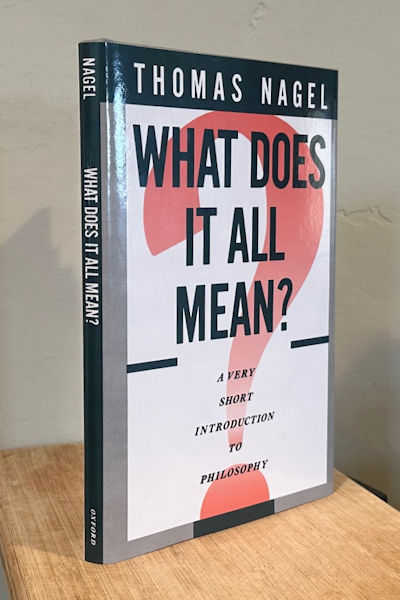 Nagel, Thomas. 1987. What Does It All Mean?: A Very Short Introduction to Philosophy. Oxford. ***
Very short introduction to the classic problems of philosophy, without historical perspective or mention of particular philosophers. Topics include how we know anything; the mind-body problem; free will; right and wrong; the meaning of life. My key thought as I read this was that science has, in fact, in recent decades, resolved some of these matters, and I wonder to what extent philosophy students are taught that. The problems may be classic, but some of the debates are obsolete. Nagel summarizes the debates, and doesn’t mention science. (post) (Read Feb 2024)
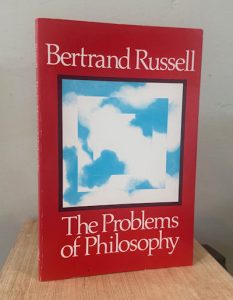 Russell, Bertrand. 1959. The Problems Of Philosophy. Oxford Univ Press. *** 1/2
A short book about the most basic issues of philosophy: how do we know what’s real? How do we know what’s so? Russell drills through “common sense” notions about these issues to their core meanings. Some of the puzzles Russell examines have been illuminated by discoveries in recent decades in evolutionary psychology, animal perceptions, and the diversity of human cultures. His insights on the value of philosophy are profound: it’s a way of breaking out of what is essentially a conservative mindset and instead contemplating the greater reality outside one’s own interests (in much the way, I would say, science fiction can); the post has a couple long quotes. (post) (Read Jan 2024)